




The Alberta Employment Standards Code contains many of the legal minimum employment rights and protections for employees in Alberta. We can help employees understand these rights and protections and fight for fair treatment.
Employee Rights
Alberta Employment Standards
All employees are entitled to be paid for their work. Employers are not allowed to refuse to pay their employees what they are owed regularly, even where the employer is having financial difficulty. Employees who are owed salary, other wages, or termination pay can sue their employers in court or file employment standards complaints.
Most employees in Alberta have rights and protections under the Employment Standards Code (the “Code”).
Vacation Pay and Vacation Time Entitlements
Most employees are entitled to vacation pay, holiday pay, and overtime pay under the Code.
Code vacation pay is usually a minimum of 4% or 6% of your average earnings, depending on how many years you have worked there. Vacation time is usually a minimum of 2 or 3 weeks per year and is also determined by length of employment.

General Holiday Pay in Alberta
Statutory holidays are officially called general holidays in Alberta. General holidays which occur on a day an employee would usually work will result in a day off with pay or 1.5 times salary for the workday. The general holidays in Alberta listed in the Code are New Years Day, Family Day, Good Friday, Victoria Day, Canada Day, Labour Day, Thanksgiving Day, Remembrance Day and Christmas Day. The general holidays do not currently include Boxing Day or the National Day for Truth and Reconciliation.
Minimum Wage and Maximum Hours of Work
Most employees have a right to the current minimum wage of $15 per hour, and cannot be required to work more than a 12 hour shift except in emergencies. Students under 18 years old get minimum wage of $13 per hour.
There is a special minimum wage of $598 per week for these sales employees: commissioned salespersons doing outside sales, car or truck salespersons, recreational vehicle salespersons, manufactured home salespersons, farm machinery salespersons, construction equipment salespersons, and land agents.
The “rule of 3” is a minimum pay rule in Alberta requiring employers to pay employees for at least 3 hours of work on each scheduled shift, even if they work less than three hours.
Termination Notice and Termination Pay Rights
Most employees are entitled to termination notice and termination pay when their employment is dismissed. The minimums listed in the Code range from 0 to 8 weeks, depending on how long the employment was:
- one week, if the employee has been employed by the employer for more than 90 days but less than 2 years,
- 2 weeks, if the employee has been employed by the employer for 2 years or more but less than 4 years,
- 4 weeks, if the employee has been employed by the employer for 4 years or more but less than 6 years,
- 5 weeks, if the employee has been employed by the employer for 6 years or more but less than 8 years,
- 6 weeks, if the employee has been employed by the employer for 8 years or more but less than 10 years, or
- 8 weeks, if the employee has been employed by the employer for 10 years or more.
Employees of less than 90 days are in the Code’s probationary period and are not entitled to termination notice under the Code.
Many on-site construction employees are not entitled to any Code termination notice.
Oilwell drilling employees employed for a definite period or task are also not entitled to any Code termination notice.
If the employer has just cause for dismissal of the employee, no termination notice is owed.
Termination pay is calculated based on the employee’s regular wages and can be paid in lieu of a termination notice period. Employment standards termination pay amounts cannot be reduced due to “mitigation income” if you get a job shortly after dismissal.
Wrongfully dismissed employees are usually entitled to more reasonable notice (severance) at common law than their minimum Code termination pay.
Overtime Pay or Time Off in Lieu
Most employees are required to be provided with overtime pay for any hours worked exceeding 8 hours per day or 44 hours per week, whichever is higher. Below are two different working schedules and the resulting overtime hours that would be earned:
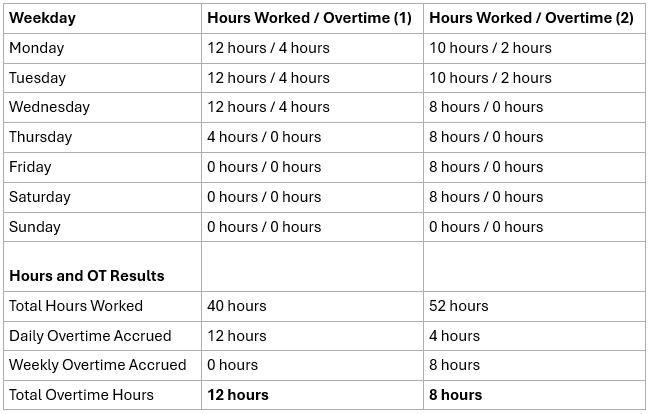
An employer is normally required to pay employees for overtime hours at the rate of 1.5x their normal wages. Employees and employers can enter overtime agreements which allow the employer to provide the employee time off with pay instead of overtime pay. Time off with pay instead of overtime is allowed to be at the employee’s ordinary wage rate instead of the 1.5x overtime pay rate.

Overtime Exceptions and Special Rules for Some Occupations
There are a number exceptions and special rules in the Code and its Regulations for the minimum wages, hours of work, overtime, vacation pay, holiday pay, termination notice, and termination pay for many types of listed occupations. The special occupations include managers, certain kinds of salespeople, many regulated professions, farm workers, caregivers, some construction workers, teachers, real estate brokers, securities dealers, caregivers, ambulance attendance, oilfield employees, taxi drivers, truck drivers and firefighters.
Managers and Professionals Rules
The Code’s Regulations are clear that managers or supervisors are not generally entitled to Code overtime pay. However, if the employee’s duties are similar to those performed by non-managerial or non-supervisory employees, they are entitled to overtime.
Employees in many regulated professions are not entitled to overtime under the Code. The overtime exemption applies to architects, accountants, chiropractors, dentists, engineers, lawyers, optometrists, podiatrists, psychologists, veterinarians, agrologists, denturists, and IT professionals.
Employees of any kind are often entitled to overtime under employment contracts or verbal understandings, but this is a common law right outside the Code. The common law claim for overtime arises sometimes with managers and professionals.
Rules for Salespeople, Oilfield Employees, Land Surveyors, Loggers
Some salespeople are not entitled to overtime pay or statutory holidays (which the Code calls general holidays). This overtime and statutory holiday exemption applies to these types of sales employees: commissioned salespersons doing outside sales, car or truck salespersons, recreational vehicle salespersons, manufactured home salespersons, farm machinery salespersons, construction equipment salespersons, real estate brokers, securities dealers, and insurance agents.
Oilwell servicing employees have special overtime rules, which require overtime on hours exceeding 12 per day or 191 hours per month, whichever number is higher for the month. Land surveyors and loggers have the monthly 191 hours threshold as well, but for them the daily overtime is anything above 10 hours.
Construction Employee Rules
Highway construction employees get overtime, but as an exception to the normal overtime rules, they get the greater of 10 hours per day or 44 per week as overtime pay.
Many on-site construction employees receive 3.6% of wages for statutory holiday pay and 6% for vacation pay, in place of the typical general holiday pay rules.
Taxi Driver, Truck Driver, Firefighter Employee Rules
For taxi drivers, overtime is the higher of 10 hours per day or 60 per week. For truck drivers and bus drivers outside cities, overtime is the greater of 10 per day or 50 per week.
Firefighters get overtime for any time past regular scheduled shifts, and could get additional overtime if their average weekly hours over a 26-week period are over 44 hours.
Employment Contracts and Greater Benefits
Remember that the Code only describes the legal minimums for most employee benefits. Written or verbal employment contracts for any employee often provide greater benefits to employees than the minimums stated in the Code. Where this happens, the employer cannot normally use the Code as a reason to refuse the benefits in the employment contract.

Employee Protections
Job-Protected Leaves Under Alberta Employment Standards
Alberta employees are entitled to many different employment standards protections under the Code. Some of the biggest protections are all the job-protected leaves.
A job-protected leave is guaranteed, unpaid time off work for certain life events. An employer cannot terminate your employment for taking a job protected leave.
The main job protected leaves are maternity leave, parental leave, bereavement leave, reservist leave, long term illness leave, critical illness of child leave, compassionate care leave, domestic violence leave and personal and family responsibility leave.
Maternity Leave and Parental Leave Rights
Maternity Leave is unpaid job protected leave for a pregnant employee which starts before the delivery date and lasts 16 weeks. After that time, a mother on maternity leave can start parental leave which lasts another 62 weeks under the Alberta Employment Standards Regulation, for a total of 78 weeks.
Parental leave is unpaid job protected leave available to a parent or adoptive parent for 62 of the first 78 weeks following the birth of the child.
Bereavement Leave Protections
Bereavement leave is job-protected leave for employees who have a family member die or experience a miscarriage. The protection lasts for 3 days and is guaranteed for most employees.
Long-Term Illness Leave for Alberta Employees
Long Term Illness leave is job-protected leave for up to 27 weeks in a calendar year for injury or illness of an employee. The number of protected weeks increased from 16 weeks to 27 weeks on January 1, 2026.
Employment Contracts and Enhanced Leave Benefits
Remember that the Code only describes the legal minimums for things like maternity leave and other protected leaves and benefits. Written or verbal employment contracts for any employee often provide greater leaves and other protections or benefits to employees than the minimums stated in the Code.
Employment policies sometimes also contain greater protections than the minimums stated in the Code. As an example, some company maternity leave policies provide for wage top-ups during some or all of a maternity leave so that the new parent is not solely receiving EI payments.
Where an employment contract or policy provides greater protections to the employee than the Code, this will normally be upheld by the courts.
Human Rights Protections and Job-Protected Leaves
Also keep in mind that several of the job protected leaves involve matters that are also protected in human rights, including especially maternity, physical disability, mental disability, and family status.

Employment Standards Complaints
Employees whose minimum rights or protections have been violated by their employers can usually file a complaint with Alberta employment standards while employed or within 6 months of when employment ends.
Employees that have a claim for termination notice or termination pay (statutory severance) can file a complaint within 6 months of when employment ends.
Employees with claims for unpaid wages can file a complaint with employment standards while employed or within 6 months of when employment ends.
In many cases, an employee with a valid employment standards complaint will have other valid legal claims against their employer and can sue for everything in court. For instance, an employee entitled to termination pay under the Code is often entitled to reasonable notice (severance) at common law, and can sue for the whole in court. A claim for pay in lieu of reasonable notice for wrongful dismissal or constructive dismissal can normally be brought within 2 years of the dismissal.
The lawyers at Bow River Law can advise you on your options regarding employment standards rights and protections, and help you pursue them.

Alberta Employment Standards Blog Posts